Snackwerks X-ray Validation
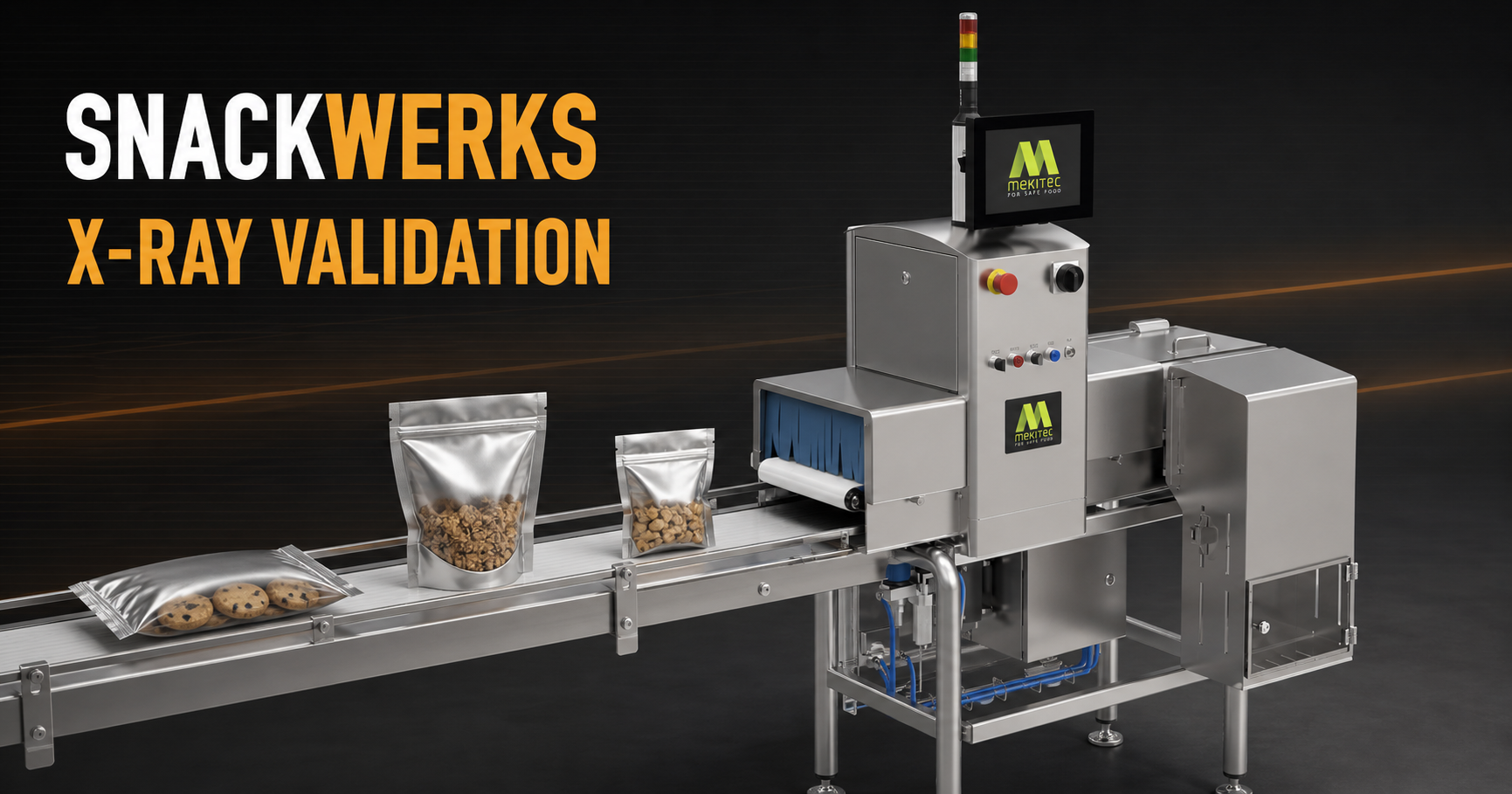
How Snackwerks Validated X-ray Inspection for Metallized Snack Packaging
Snackwerks needed to inspect cookies and granola in metallized packaging without adding unnecessary product handling or slowing production. The solution was a three-system X-ray inspection setup supported by documented validation on real products.
By a Food X-ray Inspection Expert at Mekitec with 10 years of industry experience
The Challenge
Snackwerks is a flexible snack manufacturer based in Battle Creek, Michigan. Its 40,000-square-foot facility operates three semi-automated production lines producing cookies, granola, bites, and bars.
The company inspects products packed in pillow pouches, stand-up pouches, and trays. Many of these products use metallized film, making standard metal detection unsuitable for the application.
Snack products also present a technical inspection challenge. Cookies naturally vary in thickness, shape, and internal structure, while granola creates an irregular X-ray image as pieces overlap and move inside the package. Inspection settings must separate this normal variation from an actual foreign object.
“Snack inspection must be validated with the real product and packaging. A test piece detected on an empty conveyor does not demonstrate how the system will perform with variable-density cookies or granola moving at production speed.”
— Food X-ray Inspection Expert, Mekitec
The Inspection Setup
Snackwerks installed its first Mekitec X-ray system in 2021 and expanded to three MEKI ONE systems by 2026.
The systems combine X-ray inspection with automatic rejection, a reject bin, and reject confirmation. This allows the control process to verify both that a suspect package was detected and that it was removed from the production flow.
One documented project specified a conveyor speed of 2 feet per second, approximately 36.6 metres per minute. In the customer interview, Snackwerks reported running a newer installation at up to 150 pouches per minute.
According to Snackwerks, using X-ray inspection reduced product handling while allowing production to maintain the required throughput.
Validation Results
In April 2026, all three systems underwent product-based validation at the Snackwerks facility.
The tests used Snackwerks products and customer-supplied foreign-object detection cards. Each system’s report states that the results were based on ten successful trials.
The validation records show detection of 1.5 mm ferrous metal, 2.0 mm non-ferrous metal, 2.0 mm stainless steel, and 5.0 mm soda-lime glass. All four test-piece categories were recorded as detected on each of the three systems.
The accompanying condition inspections covered 15 categories per system. All 45 checks were marked “OK”, and all three systems passed inspection.
These results apply to the products, packaging, inspection settings, and conditions used during validation. They should not be treated as a universal detection guarantee for every snack product or production line.
Supporting Food-Safety Documentation
Snackwerks publicly lists HACCP and GMP, Food Defense, crisis management, and allergen control among its food-safety programs.
The X-ray project produced a documented evidence chain that can support the site’s QA activities and customer or retailer audits. The available records include product-based validation, defined test-piece sizes, reject-system checks, radiation measurements, condition inspections, and annual maintenance documentation.
Whether an X-ray system is formally designated as a Critical Control Point must be determined by the facility’s food-safety team through its hazard analysis. The validation demonstrates system performance under the tested conditions; it does not by itself establish certification under a named standard.
A Measurable Result
The Snackwerks case provides a clear result: three systems passed product-based validation, four specified foreign-object categories were detected at the recorded test sizes, and all 45 system-condition checks were marked “OK”.
For manufacturers working with metallized packaging or variable-density snack products, the main lesson is straightforward: inspection performance should be tested using the actual product, package, line speed, and rejection process.
Running a challenging snack application? Request an application test using your products, packaging, and target foreign objects.